







Current Equity Exposure
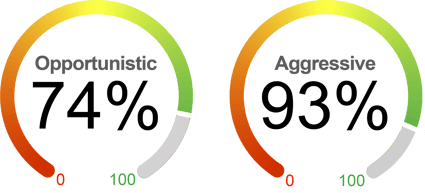
We employ two distinctive dynamic market exposure models in our strategies: one tailored for growth-focused investors seeking aggressive opportunities and another designed for those with a more defensive approach, prioritizing capital preservation. *For illustrative purposes only.
U.S. equities delivered a strong but increasingly uneven performance in the second quarter of 2026, as markets balanced resilient earnings and AI-driven optimism against renewed inflation pressures, elevated interest rates, and lingering geopolitical uncertainty. April began with a sharp rebound from March’s weakness, with major indexes finishing meaningfully higher as investors responded positively to solid economic data, supportive corporate earnings, and continued strength in technology and AI-related stocks. While the Middle East conflict remained a source of uncertainty, easing oil prices later in the month and signs of diplomatic progress helped improve sentiment.
As the quarter progressed, market momentum continued but became more valuation-sensitive. May saw another strong advance in U.S. equities, led by the Nasdaq, as AI-related capital spending and earnings strength helped offset concerns around inflation and geopolitical risk. Corporate earnings remained broadly supportive, and the gap between mega-cap technology earnings growth and the broader market continued to narrow. At the same time, inflation pressures accelerated, driven largely by higher energy costs, rising producer prices, and signs that businesses were increasingly passing higher costs through to consumers. Treasury yields moved sharply higher as investors repriced expectations for Federal Reserve policy, compressing equity risk premiums and leaving valuations more vulnerable to further rate pressure.
By June, performance became more mixed as investors rotated away from richly valued, interest-rate-sensitive technology stocks and toward more defensive and cyclical sectors, including financials, industrials, and healthcare. The Federal Reserve left interest rates unchanged but adopted a more hawkish tone, with updated projections suggesting rate cuts are unlikely this year. Higher yields continued to pressure valuation multiples, particularly across growth-oriented areas of the market. At the same time, progress toward a U.S.-Iran agreement helped ease concerns around a prolonged disruption to global energy supplies, supporting broader market sentiment.
Despite these headwinds, the underlying economic backdrop remained relatively durable. Growth appears to be slowing but still positive, while labor market data continued to surprise to the upside. Corporate earnings momentum, particularly from AI-related investment and productivity gains, remains a key support for equities. However, risks have become more balanced, with stretched valuations, inflationary pressures, and uncertainty around Fed policy creating a more challenging backdrop than earlier in the quarter.
With this backdrop, the outlook for U.S. equities remains supportive but more selective. We continue to see opportunities driven by earnings growth, economic resilience, and AI-related productivity gains, while remaining mindful of valuation sensitivity and higher-for-longer interest rates. During the quarter, we reduced equity exposure from to 74% in our defensive, tailored approach and maintained that positioning through quarter-end.
What's Driving the Markets?
Federal Reserve Meeting: As widely expected, the Fed left the federal funds rate unchanged at during its June meeting, but policymakers adopted a more hawkish tone. In the updated economic projections, the forecast for headline PCE inflation at year-end was revised up from 2.7% in March to 3.6% while the core PCE was up from 2.7% to 3.3%. Higher inflation expectations and a relatively stronger labor market have led policymakers to anticipate a rate hike in 2026 and a steeper interest-rate path rather than rate cuts. The June meeting was also the first FOMC meeting under the new Chair Kevin Warsh, who introduced a more concise post-meeting statement and omitted the publication of dissenting votes. Consistent with the Fed's updated outlook, we anticipate policy rates will remain unchanged for the foreseeable future. The more hawkish Fed guidance led to higher Treasury yields and some short-term headwinds for the equity market, especially growth stocks with elevated valuations.
Macro Environment: Recent US economic data has shown generally positive momentum entering the second half of the year. Consumer spending remains robust, driven by rising wealth, especially among upper-income households, a low unemployment rate, and rising real wage income. The May payroll report surprised to the upside for the third consecutive month, with payroll employment rising by 172,000 in May and by an average of 181,000 for the last three months. Also, US manufacturing activity expanded for a fifth straight month in May, as indicated by an above-neutral level of the ISM Manufacturing Index. Inflation is accelerating primarily due to higher energy prices, but it has not yet become a growth shock large enough to derail the positive growth momentum. The year-over-year headline consumer price index jumped 4.2% in May, its fastest growth since early 2023. Wholesale prices were also climbing, with the yearly producer price index up to 6.5% in May from 5.7% in April.
Easing Middle East Tensions: In June, progress toward a US-Iran agreement helped ease concerns of a prolonged disruption to global energy supplies and supported market sentiment. The agreement has led to a rapid recovery in oil flows through the Strait of Hormuz, with retreating oil prices and reduced inflation pressure. Brent crude declined roughly 20% during the month, with WTI falling to about $70 per barrel. Declining energy prices especially supported sectors vulnerable to higher input prices and consumer spending. Although geopolitical risks continue to linger, easing tensions helped to offset concerns over a more hawkish outlook for Fed policy.
By the Numbers
Valuation
|
Sentiment
|
Technical
|
Macroeconomic
|