







Current Equity Exposure
We employ two distinctive dynamic market exposure models in our strategies: one tailored for growth-focused investors seeking aggressive opportunities and another designed for those with a more defensive approach, prioritizing capital preservation. *For illustrative purposes only.
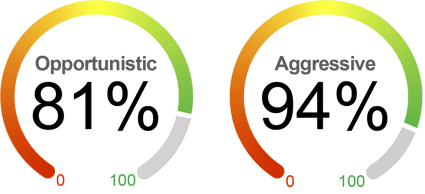
US equities experienced a volatile month in July 2026 as investors continued to rotate away from elevated valuations in AI and tech stocks to more defensive sectors. The S&P 500 and the Dow were both flat for the month, while the Nasdaq Composite underperformed with a 3.2 % loss. Investors became more concerned that the excess AI infrastructure capital spending could pressure future profitability of the sector, triggering a sell-off in July. Also, the Fed left the federal funds rate unchanged in July, with three dissents preferring a rate hike, reiterating a cautious higher-for-longer stance in the face of elevated energy prices. Higher oil prices also revived inflation concerns and contributed to rising Treasury yields, compressing equity valuations and weighing more heavily on growth-oriented sectors. While the current short-term volatility will persist, we believe that the medium-term outlook for US equities remains supportive, driven by resilient growth and solid corporate earnings. However, downside risks have increased amid stretched valuations, inflationary pressures, and interest-rate and Fed policy uncertainties. With this backdrop, we took the opportunity of the stock selloff to slightly increase our equity exposure to 81% in our defensive, tailored approach.
What's Driving the Markets?
AI stock selloff: Investors continued to sell chip stocks this month, amid rising concerns over excess AI infrastructure spending and rising competition from China. While the Nasdaq has underperformed the broader market of S&P 500, the weakness has been concentrated in semiconductor companies such as NVIDIA, AMD, and Micron. After NVIDIA reported that the company would support a $250 billion AI project, skepticism has intensified about whether excessive AI capital spending in the industry will generate significant returns. Investors were also concerned about growing competition from China’s semiconductor industry, with news of mass production of domestic deep ultraviolet and the public listing of CXMT. The elevated valuations of AI stocks and the rotation toward more defensive stocks, due to a high interest rate environment, also contributed to the July corrections. In our view, the AI sector is likely to be volatile in the near future as investors monitor second-quarter earnings, companies’ capital spending plans, and Fed policy. However, we believe the medium-term AI investment cycle remains compelling as corporate adoption of AI is expanding and demand for productivity improvements in AI remains intact.
Fed Policy: As widely expected, the Fed left the federal funds rate unchanged at 3.50% to 3.75% at its July meeting, but pressure to raise the policy rate is increasing. Three dissents preferred a 25 bps rate hike rather than maintaining the current rate, marking the first time in ten years that three members disagreed in the same direction. Although the vote appeared hawkish, many investors interpreted several of Chairman Warsh’s remarks as relatively dovish. The intensifying conflict in the Middle East has led to higher energy prices, raising concerns about spillover effects into the broader economy. Although the energy shock pushed the US Consumer Price Index up to 4.2% in May, inflation moderated to 3.5% in June. Renewed conflict will keep consumer prices high in the near future. In our view, policymakers need more evidence that higher energy prices are leading to rising prices in broader categories. We expect the Fed to keep the policy rate unchanged in 2026.
Q2 earnings: By July 31, 2026, 61% of S&P 500 companies have reported Q2 2026 earnings, 86% have reported a positive EPS surprise, and 77% have reported a positive revenue surprise. For Q2 2026, the blended (year-over-year) earnings growth rate for the S&P 500 is 47.4% year over year, significantly beating the consensus forecast. The earnings report is strong across the board, with 8 sectors delivering double-digit earnings growth. Every major US bank beat expectations, with Goldman Sachs’ EPS beating consensus by 46% and Morgan Stanley’s net income rising 60%. However, AI companies such as OpenAI have missed sales targets, intensifying concerns about the sustainability of AI capital spending.
By the Numbers
Valuation
|
Sentiment
|
Technical
|
Macroeconomic
|