






Back to resources
Market Insights

August Market Recap and Current Market Drivers

Rising Yields, Resilient Equities


Background
Overlay
Overlay

Current Equity Exposure

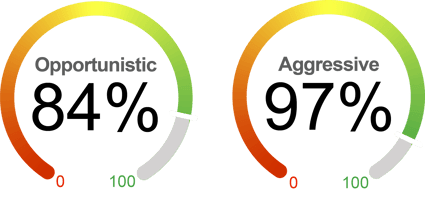
We employ two distinctive dynamic market exposure models in our strategies: one tailored for growth-focused investors seeking aggressive opportunities and another designed for those with a more defensive approach, prioritizing capital preservation.  *For illustrative purposes only.
Asset 154@4x-8

US equities delivered modest gains in August, with the S&P 500 and the Dow climbing 2.7% and 1.5%, respectively, while the Nasdaq Composite outperformed by advancing 4.0%. Strong corporate earnings and continued AI-related investment supported sentiment, with NVIDIA’s exceptionally strong earnings report boosting the tech sector. At the same time, investors remained concerned about higher yields driven by elevated inflation, a large fiscal deficit, uncertain fiscal policy, and heavy private investment. The US 30-year yields have hit a 19-year high of 5.3%.  All eyes were on the Jackson Hole Symposium at the end of the month, and Chair Warsh delivered a speech with a more hawkish tone than expected by reaffirming the Fed’s 2% PCE inflation target and indicating possible tightening if inflation does not move toward the target. We remain moderately constructive on US equity, driven by resilient growth, healthy corporate earnings, and strong AI-related investments. However, downside risks remain amid stretched valuations, inflationary pressures, and interest-rate and Fed policy uncertainties. With this backdrop, we maintained our equity exposure at 84% in our defensive, tailored approach.

What's Driving the Markets?

Treasury Buyback: On August 19, 2026, Treasury announced that it would double the maximum size of its long-end buyback operations from $2 billion to $4 billion per operation for its longer-dated securities, beginning September 9. The current buyback program is primarily designed as a liquidity-management tool, rather than conventional QE. Treasury is buying older, less-liquid "off-the-run" securities, particularly in the 10–20-year and 20–30-year sectors, and it does not permanently remove debt. The immediate market reaction was positive: the 30-year yield declined about 9 bps to 5.19%, while the 10-year yield dropped about 6 bps to 4.65%. It also had a moderate yield-curve flattening effect, as the long-term yield dropped more than the front end of the curve. Overall, we would view the buyback as short-term liquidity support, rather than a fundamental solution to the fiscal problem. This is consistent with the subsequent market reaction: the 30-year yield moved higher after the initial decrease as investors questioned whether the buyback program was big enough to address the underlying problem.

Inflation and Employment: Payroll data indicated the labor market was softening in July, with employment falling by 23,000, well below consensus. The government and leisure industries saw significant job losses, overshadowing the mild gain in healthcare. Previous months’ data were also revised downward, leading to the three-month average declining from 111,000 in June to 20,000 in July. Although the unemployment rate ticked down to 4.1%, it was primarily driven by a decrease in the labor force. The July employment report has significant implications for the Fed’s rate policy. While growing inflation pressure has increased the expectations that the Fed could raise rates this year, a significantly weakening labor market would reduce the probability of rate hikes. At the same time, recent inflation data was tame, with a 0.1% monthly increase in headline CPI and a 0.22% increase in core CPI, bringing year-over-year growth in headline and core CPI to 3.4% and 2.5%, respectively.

Jackson Hole Symposium: Chair Warsh delivered a speech that was notably more hawkish than market expectations at the Jackson Hole Symposium. In the speech, Chairman Warsh indicated a willingness to tighten policy if inflation does not move toward the 2% target. In particular, he emphasized that, "The Fed's price-stability objective of 2%, as measured by the personal consumption expenditures (PCE) price index, is a firm, fixed target." He also clarified the July hold by saying, "And we expressed our joint readiness to act as circumstances might require." Warsh noted that growth appears to have strengthened, but the recent improvement in inflation data "does not tell me that underlying trends have meaningfully improved." After the speech was released, the two-year Treasury yield, which is more sensitive to expectations for what the Fed will do with the fed funds rate, was up 7 bps. Also, market expectations for the probability of a September hike moved from 35% to nearly 60%.
.

By the Numbers

Valuation

  • Valuation metrics for equity were mixed. P/E decreased from 27.6 at the end of July to 26.0 at the end of August.
  • Forward P/E increased from 21.1 at the end of July to 21.4 at the end of August.
  • Inflation-adjusted valuation metrics continued to be negative.
  • Equity valuation metrics relative to bonds remained negative with high bond yields.

Sentiment

  • U.S. manufacturing activity expanded in July, increasing from 53.3 in June to 55.6. The new orders and production indexes increased and remained in expansionary territory.
  • The University of Michigan Consumer Confidence Index declined from 55.2 in July to 51.7 in August, with a weakening labor market and stubborn inflation.
  • The NAHB index inched up 1 point to 35 in August, well below the 50-point neutral threshold.

Technical

  • Technical indicators were positive overall, with positive momentum signals and fear indexes offsetting neutral reversal signals.
  • The S&P 500 was 8% above its 200-day moving average, 3% above the 100-day average, and 2% above the 50-day average.
  • The VIX declined in general this month with strong equity performance and robust earnings, falling from around 16 to about 14 by late August. It picked up at the end of the month with a more hawkish Fed outlook.

Macroeconomic

  • Nonfarm payrolls in July decreased by 23,000, coming in well below expectations with significant downward revisions to prior months. The unemployment rate ticked down to 4.1%. Initial jobless claims remained low, with the four-week moving average increasing slightly to 205,500 as of August 22.
  • Retail sales fell 0.6% in July and year-over-year growth slowed to 5% in total and 4.8% for core sales.
  • US industrial production increased 0.2% in July, below consensus expectations.


As of 8/31/26. Data provided by Bloomberg, NorthCoast Asset Management, Federal Reserve History.

The NorthCoast Navigator is a market barometer displaying NorthCoast's current U.S. and international equity exposure and outlook. This aggregate metric is determined by multiple data points across four broad market-moving dimensions: Technical, Sentiment, Macroeconomic, and Valuation. The daily result determines equity exposure in our tactical strategies. 

NorthCoast Asset Management LLC (“NorthCoast”) is an investment adviser registered with the United States Securities and Exchange Commission (SEC). Registration with the SEC or any state securities authority does not imply a certain level of skill or training. More information about NorthCoast can be found at www.northcoastam.com.

NorthCoast and its affiliates do not provide tax, legal or accounting advice. This material has been prepared for informational purposes only, and is not intended to provide, and should not be relied on for, tax, legal or accounting advice. You should consult your own tax, legal and accounting advisors before engaging in any transaction.
 
The information contained herein has been prepared by NorthCoast Asset Management ("NorthCoast") on the basis of publicly available information, internally developed data and other third party sources believed to be reliable. NorthCoast has not sought to independently verify information obtained from public and third party sources and makes no representations or warranties as to accuracy, completeness or reliability of such information. All opinions and views constitute judgments as of the date of writing without regard to the date on which the reader may receive or access the information, and are subject to change at any time without notice and with no obligation to update. This material is for informational and illustrative purposes only and is intended solely for the information of those to whom it is distributed by NorthCoast. No part of this material may be reproduced or retransmitted in any manner without the prior written permission of NorthCoast. NorthCoast does not represent, warrant or guarantee that this information is suitable for any investment purpose and it should not be used as a basis for investment decisions. © 2026 NorthCoast Asset Management.
 
PAST PERFORMANCE DOES NOT GUARANTEE OR INDICATE FUTURE RESULTS.
 
This material should not be viewed as a current or past recommendation or a solicitation of an offer to buy or sell any securities or investment products or to adopt any investment strategy. The reader should not assume that any investments in companies, securities, sectors, strategies and/or markets identified or described herein were or will be profitable and no representation is made that any investor will or is likely to achieve results comparable to those shown or will make any profit or will be able to avoid incurring substantial losses. Performance differences for certain investors may occur due to various factors, including timing of investment. Investment return will fluctuate and may be volatile, especially over short time horizons.
 
INVESTING ENTAILS RISKS, INCLUDING POSSIBLE LOSS OF SOME OR ALL OF THE INVESTOR'S PRINCIPAL.
 
The investment views and market opinions/analyses expressed herein may not reflect those of NorthCoast as a whole and different views may be expressed based on different investment styles, objectives, views or philosophies. To the extent that these materials contain statements about the future, such statements are forward looking and subject to a number of risks and uncertainties.

Latest Resources

Private Wealth Management

Why Naming a Beneficiary Is Important in Financial Planning

What Is a Beneficiary? Naming a beneficiary helps determine who will receive certain assets after...

Learn more
Market Insights

July Market Recap and Current Market Drivers

Learn more
Private Wealth Management

Planning for a Child's Financial Future

Making this decision usually begins with purpose, not the account itself. Are the funds intended...

Learn more