




Investing in the equity market is often presented as a fairly simple choice: participate in its long-term growth potential and accept the declines that come with it, or reduce market exposure and accept less growth potential.
NorthCoast’s Defined Outcome Strategies introduce more choices between those two ends of the spectrum. To see an example you can jump straight to our example at the bottom of this article
Instead of automatically accepting the market’s full upside and full downside, investors can select a more specific combination of participation and protection. They can decide how closely an investment should participate in a rising market, how much downside exposure they are prepared to accept, and how long those terms should apply.
The purpose is not to predict the market’s next move. It is to decide in advance how a particular part of the portfolio should respond when the market moves.
For investors seeking greater control over the risks they assume, NorthCoast provides a range of defined outcome choices designed to address different objectives, concerns, time horizons, and levels of risk tolerance.
What Is a Defined Outcome Strategy?
A defined outcome strategy establishes rules for how an investment will participate in the movement of a selected market index during a stated outcome period.
Those rules generally address four questions:
- Which market index will the investment reference?
- How will the investment participate if the index rises?
- How much protection will apply if the index falls?
- Over what period are those terms designed to apply?
This creates a more precise investment conversation.
Rather than simply describing an investor as “moderate” or “conservative,” a NorthCoast advisor can help the investor consider the actual tradeoffs as it pertains to their financial situation.
Is the investor comfortable accepting a small, defined amount of downside to retain greater market participation? Would the investor prefer more complete protection, even if that significantly reduces the available upside? Can the investor remain invested for the entire outcome period?
Different answers lead to different structures. Our range of defined outcome strategies allows the investor and advisor to identify a combination that more closely reflects the intended role of the assets.
Understanding the Available Choices
Defined outcome strategies do not all work the same way. NorthCoast offers different combinations of upside participation and downside protection because investors do not all face the same financial circumstances.
Understanding four basic features makes those choices easier to evaluate.
Upside participation rate
A participation rate determines how much of a positive index return the investment is designed to receive.
For example, a 70% participation rate means the investment is designed to receive approximately 70% of a positive index return, subject to the strategy’s complete terms. If the index rises, the investment participates at the stated rate.
Upside cap
An upside cap establishes the maximum index gain in which the investment can participate.
Once the cap is reached, the investment does not participate in additional index gains during that outcome period. The investor accepts that ceiling in exchange for the downside protection or other features built into the structure.
Downside buffer
A buffer is designed to absorb an initial portion of an index decline.
With a 10% buffer, for example, the investment would be designed to absorb the first 10% of an index loss at the end of the outcome period. If the index fell by more than 10%, the investor would generally be exposed to the portion of the decline beyond the buffer, subject to the investment’s complete terms.
Downside floor
A floor establishes the investment’s intended maximum exposure to an index decline at the end of the outcome period.
A -5% floor, for example, means the investment is designed to limit the effect of an index decline to approximately 5%, even if the referenced index falls considerably more. A 0% floor provides greater protection from an index decline, but generally leaves less capital available to create upside participation.
Not every defined outcome strategy uses every feature. One may combine an upside cap with a downside buffer. Another may combine an upside participation rate with a downside floor.
A Purpose-Built Role in the Portfolio
Defined outcome investing is not necessarily intended to replace an investor’s entire portfolio. A NorthCoast Defined Outcome Strategy can be used for a particular allocation with a particular job.
That job might be to:
- Retain meaningful equity-market participation
- Reduce exposure to a major index decline
- Protect assets intended for a future financial need
- Generate income while managing a defined form of downside exposure
NorthCoast’s strategies are designed to provide daily liquidity and transparency. Investors should understand the referenced index, participation terms, protection level, and outcome period before investing.
NorthCoast may use exchange-traded funds, Treasury instruments, and index options to create these defined outcomes. Although the construction is sophisticated, the objective remains clear: establishing a tailored balance between market opportunity and downside exposure.
Tax efficiency is an objective rather than a guaranteed result and will depend on the investor’s individual circumstances.
The clearest way to understand the potential value is to see how one of these structures could address a real financial concern.
A Preservation-Oriented Example
Consider a recently retired couple who have accumulated enough assets to support their planned lifestyle.
They are not trying to maximize every possible dollar of market appreciation. Their greater concern is preventing a significant portfolio decline early in retirement, when they may also need to begin taking distributions.
At the same time, moving the entire allocation to cash or traditional fixed income may not appeal to them. They still want a portion of their assets connected to the equity market, particularly because their retirement may last for decades.
Suppose the couple allocates $1,000,000 to a defined outcome investment with the following terms:
- Approximately 70% participation in positive S&P 500 returns
- Designed to limit losses to 5% at the end of the outcome period, even if the S&P 500 finishes flat or declines. This will cause a 5% starting downside once S&P 500 participation begins.
- An outcome period of approximately 2 years
Unlike a strategy with an upside cap, this structure does not stop participating after the market reaches a certain level. Instead, it is designed to participate in approximately 70% of any positive S&P 500 return.
The following examples show what these simplified strategy terms could mean for their $1,000,000 investment:
| S&P 500 return | Approximate strategy return | Approximate ending value |
|---|---|---|
| -30% | -5% | $950,000 |
| -10% | -5% | $950,000 |
| 0% | -5% | $950,000 |
| +10% | +2% | $1,020,000 |
| +20% | +9% | $1,090,000 |
| +30% | +16% | $1,160,000 |
The positive-return examples reflect the structure’s starting downside of 5% and 70% participation in a positive index return. For example:
If the S&P 500 gains 20%, 70% participation would contribute 14%. After accounting for the structure’s 5% starting downside, the illustrative strategy return would be 9%.
The same structure limits the effect of a negative market outcome. If the S&P 500 declines by 10%, 20%, or 30%, the strategy is designed to limit the loss to 5% at the end of the outcome period.
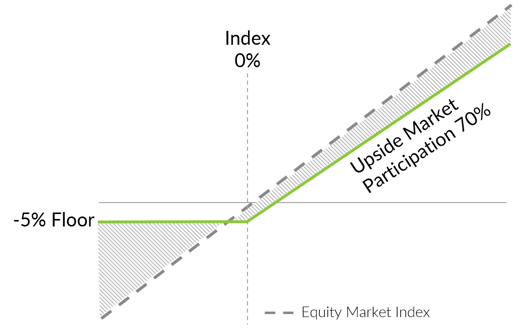 The couple is therefore making a specific choice: “We are willing to accept a potential 5% loss and receive less than the market’s positive return in exchange for protection against a much larger market decline.”
That is the practical purpose of the investment. The couple retains substantial equity-market participation while establishing a limit on the amount that this allocation is intended to lose, assuming the position is held through the end of the outcome period.
How Is This Outcome Created?
The investment divides the couple’s allocation between two functions.
Some of the capital is placed in a Treasury-based instrument intended to provide a predictable value at the end of the outcome period. Another portion is used to purchase S&P 500 call options, which create the equity-market participation.
In simplified terms:
- The Treasury component establishes the foundation for the ending value.
- The options provide participation when the S&P 500 rises.
- Purchasing more options increases the participation rate.
- Using more of the allocation to purchase those options reduces the amount supporting the downside floor.
This is why the strategy can provide approximately 70% upside participation but has a downside floor of approximately -5%. The investor accepts a small, predetermined amount of downside so that more capital can be used to obtain equity-market participation.
A structure offering a 0% floor could provide greater protection, but it would have less capital available for options and therefore a substantially lower participation rate. The investor is choosing between two valuable features: more protection or more participation.
Making the Tradeoff Intentional
Every investment involves tradeoffs. Defined outcome investing makes those tradeoffs more explicit by allowing investors to choose how much market participation they want, how much downside exposure they are prepared to accept, and the period over which those terms are designed to apply.
As the example illustrates, the choice does not have to be between accepting the equity market’s full risk and avoiding equities altogether. An investor may be able to retain meaningful participation in a rising market while placing a defined boundary around the effect of a significant index decline at the end of the outcome period.
NorthCoast offers a range of Defined Outcome Strategies because no single combination of participation and protection will be appropriate for every investor. The right structure depends on the investor’s objectives, risk tolerance, time horizon, liquidity needs, tax circumstances, and the role the allocation is intended to serve within the broader portfolio.
For investors who want to take a more deliberate approach to market risk, a conversation with a NorthCoast advisor can help clarify the available choices. Together, the investor and advisor can evaluate whether a defined outcome strategy offers an appropriate balance of participation and protection, and ensure the tradeoffs are understood before investing.
NorthCoast Asset Management LLC (“NorthCoast”) is an investment adviser registered with the Securities and Exchange Commission under the Investment Advisers Act of 1940 that provides investment management services to individual and institutional clients. Effective January 1, 2026, Kovitz Investment Group Partners, LLC changed its name to NorthCoast Asset Management LLC. The individuals responsible for portfolio management still maintain those roles with NorthCoast. From June 1, 2024 through December 31, 2025, NorthCoast Asset Management was part of Kovitz Investment Group Partners, LLC. Prior to June 1, 2024, NorthCoast Asset Management was previously overseen by Focus partner Connectus Wealth since November 1, 2021. From 2008 until November 2021, the Firm was defined as NorthCoast Investment Management, LLC. The accounts managed at the predecessor firms are sufficiently similar to the accounts managed at NorthCoast Asset Management, such that the performance results would provide relevant information to clients or investors.
NorthCoast Asset Management LLC (“NorthCoast”) is an investment adviser registered with the United States Securities and Exchange Commission (SEC). Registration with the SEC or any state securities authority does not imply a certain level of skill or training. More information about NorthCoast can be found at www.northcoastam.com.
NorthCoast and its affiliates do not provide tax, legal or accounting advice. This material has been prepared for informational purposes only, and is not intended to provide, and should not be relied on for, tax, legal or accounting advice. You should consult your own tax, legal and accounting advisors before engaging in any transaction.
The information contained herein has been prepared by NorthCoast Asset Management ("NorthCoast") on the basis of publicly available information, internally developed data and other third party sources believed to be reliable. NorthCoast has not sought to independently verify information obtained from public and third party sources and makes no representations or warranties as to accuracy, completeness or reliability of such information. All opinions and views constitute judgments as of the date of writing without regard to the date on which the reader may receive or access the information, and are subject to change at any time without notice and with no obligation to update. This material is for informational and illustrative purposes only and is intended solely for the information of those to whom it is distributed by NorthCoast. No part of this material may be reproduced or retransmitted in any manner without the prior written permission of NorthCoast. NorthCoast does not represent, warrant or guarantee that this information is suitable for any investment purpose and it should not be used as a basis for investment decisions. © 2026 NorthCoast Asset Management.
PAST PERFORMANCE DOES NOT GUARANTEE OR INDICATE FUTURE RESULTS.
This material should not be viewed as a current or past recommendation or a solicitation of an offer to buy or sell any securities or investment products or to adopt any investment strategy. The reader should not assume that any investments in companies, securities, sectors, strategies and/or markets identified or described herein were or will be profitable and no representation is made that any investor will or is likely to achieve results comparable to those shown or will make any profit or will be able to avoid incurring substantial losses. Performance differences for certain investors may occur due to various factors, including timing of investment. Investment return will fluctuate and may be volatile, especially over short time horizons.
INVESTING ENTAILS RISKS, INCLUDING POSSIBLE LOSS OF SOME OR ALL OF THE INVESTOR'S PRINCIPAL.
The investment views and market opinions/analyses expressed herein may not reflect those of NorthCoast as a whole and different views may be expressed based on different investment styles, objectives, views or philosophies. To the extent that these materials contain statements about the future, such statements are forward looking and subject to a number of risks and uncertainties.